In the current global economy, data is often described as the new oil. However, raw data is useless without a refinery. For business and marketing students entering a competitive workforce in 2026, the ability to transform chaotic numbers into actionable strategies is no longer just an “extra” skill—it is a fundamental requirement. Among the various tools available, SPSS (Statistical Package for the Social Sciences) remains the gold standard for academic research and professional market analysis.
The transition from high school to undergraduate studies often brings a sudden realization: business isn’t just about creative ideas; it’s about proving those ideas with evidence. Whether you are analyzing consumer behavior in London or supply chain efficiency in Sydney, you need a way to validate your theories. This is where many students find their workload becoming overwhelming. To stay ahead of the curve while managing complex modules, reaching out to experts to do my assignment can provide the necessary breathing room to focus on mastering these technical tools rather than just surviving the semester.
The Evolution of Business Intelligence
Years ago, a marketing manager might rely on “gut feeling” to launch a campaign. Today, that approach is a recipe for failure. Modern businesses demand statistical significance. SPSS allows students to perform complex descriptive and bivariate statistics, predictions for numerical outcomes, and predictions for identifying groups. For an undergraduate student, understanding these concepts is the difference between saying “I think people like this product” and “There is a 95% confidence interval that this product will succeed in the Gen Z demographic.”
Why SPSS Over Simple Spreadsheets?
While most students are comfortable with basic spreadsheets, they quickly hit a ceiling when dealing with “Big Data.” Spreadsheets are great for organization, but SPSS is built specifically for analysis. It handles massive datasets with ease and offers specialized features like:
- Non-parametric tests: For data that doesn’t follow a normal distribution.
- Automated Data Preparation: Identifying outliers and missing values in seconds.
- Direct Reporting: Creating publication-quality charts that look professional in a boardroom.
Bridging the Gap Between Theory and Reality
In a marketing classroom, you learn about the “Four Ps.” In the real world, you use SPSS to run a “Conjoint Analysis” to determine exactly how much a customer is willing to pay for a specific feature. This bridge between academic theory and practical application is what recruiters are looking for. They don’t just want someone who knows what a “P-value” is; they want someone who can calculate it using real-time market data.
| Feature | Excel / Standard Spreadsheets | IBM SPSS Statistics |
| Data Capacity | Limited rows; prone to crashing | Built for massive, complex datasets |
| Statistical Depth | Basic formulas and add-ons | Specialized for advanced social science research |
| User Interface | Grid-based, manual entry | Command-based and menu-driven for analysis |
| Automation | Very limited | High (Syntax allows for repeatable research) |
Mastering the Learning Curve
Let’s be honest: SPSS is not the most intuitive software at first glance. The interface can look like a relic from the early 2000s, and the “Syntax” language feels like learning to code. It is common for students to feel stuck during their mid-terms. When the data won’t clean properly or the regression analysis keeps returning errors, seeking expert Myassignmenthelp Services for spss assignment help can be a strategic move. Getting a professional walkthrough of your specific dataset doesn’t just help your grade; it clarifies the logic behind the software, making you more proficient for your future career.
The Marketing Powerhouse: Predictive Analytics
Marketing is no longer just about pretty pictures; it is about predicting the future. Using SPSS, marketing students can perform “Cluster Analysis” to segment a database into distinct customer personas. Instead of sending the same email to everyone, a business can send personalized offers based on statistically proven preferences. This level of precision is why SPSS experts often command higher starting salaries in the marketing sector.
Global Accessibility and Standardized Language
One of the best things about SPSS is that it is a global language. A marketing researcher in New York uses the same SPSS output format as a researcher in Tokyo. By mastering this tool, you are essentially gaining a universal passport for the business world. You can move across borders and industries—from healthcare management to retail analytics—without having to relearn your analytical methodology.
Preparing for the Dissertation and Beyond
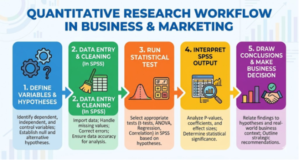
For most undergraduate and graduate students, the final hurdle is the dissertation or capstone project. These projects almost always require a quantitative element. If you haven’t mastered SPSS by your final year, your research will lack the “Expertise and Authoritativeness” (E-A-T) that professors look for. Learning the software early prevents the last-minute panic that many students face when their graduation depends on a successful ANOVA test.
Practical Tips for Undergraduate Success
- Don’t Ignore the Syntax: While you can use the drop-down menus, learning to write basic syntax will save you hours of work when you need to re-run an analysis.
- Clean Your Data First: 90% of SPSS errors come from “dirty” data—extra spaces, inconsistent naming, or missing values.
- Understand the “Why”: Don’t just click buttons. Understand what a “T-test” actually measures so you can explain your findings to a non-technical manager.
Conclusion: Your Career as a Data Storyteller
Ultimately, business and marketing are about storytelling. You are telling the story of why a product matters or why a strategy will work. Data is the “truth” that backs up your story. By becoming proficient in SPSS, you aren’t just learning a software package; you are learning how to speak the language of truth in the modern corporate world. Whether you are balancing your current workload with professional support or spending late nights in the computer lab, the investment you make in these analytical skills today will be the foundation of your professional success tomorrow.
Frequently Asked Questions (FAQ)
Q: Is SPSS still relevant in 2026 with the rise of AI?
Ans: Absolutely. While AI can process data, SPSS provides the transparency and academic rigor needed to verify AI-generated conclusions. It remains the standard for peer-reviewed research and formal business reporting.
Q: Is SPSS harder to learn than Python or R?
Ans: Generally, no. SPSS is much more user-friendly for business students because it offers a “point-and-click” interface, whereas Python and R require significant coding knowledge from day one.
Q: Can I use SPSS for qualitative research?
Ans: SPSS is primarily for quantitative (numerical) data. For qualitative research (interviews/text), tools like NVivo are more common, though SPSS can be used to code and quantify certain qualitative responses.
Q: Why do employers prefer SPSS over Excel?
Ans: SPSS minimizes the risk of manual formula errors. In a business environment, a single misplaced “sum” in Excel can lead to millions of dollars in losses. SPSS is more structured and “audit-friendly.”
About The Author
I am Alexander Anderson, a senior academic consultant and digital strategist at MyAssignmentHelp. With over a decade of experience in the educational technology sector, I specialize in helping students bridge the gap between complex theoretical concepts and practical, real-world application.